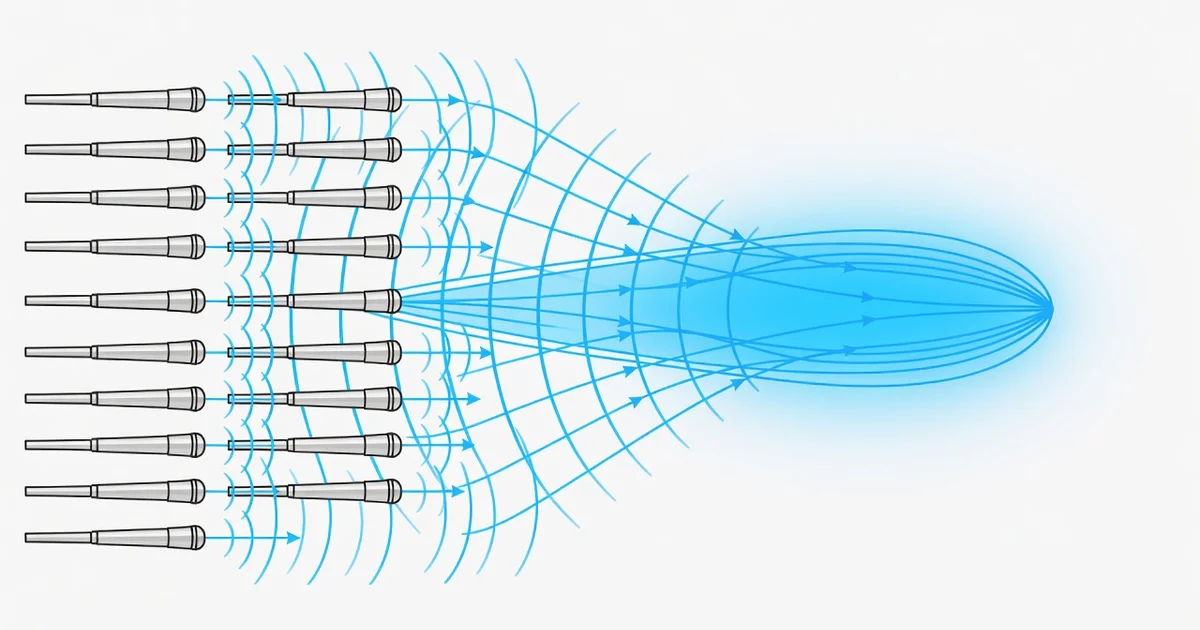
Have you ever wondered how a smart speaker can hear you from across the room, or how a video call isolates your voice from background noise? The answer often lies in acoustic beamforming — a technique that uses multiple microphones to focus on sound coming from a specific direction while suppressing everything else.
In this article, we’ll break down what acoustic beamforming is, how it works step by step, and why it matters for devices you use every day. Whether you’re an engineer, a product designer, or simply curious about audio tech, you’ll walk away with a clear, practical understanding.
Introduction
Acoustic beamforming is one of those technologies that quietly shapes modern life. When you speak to a smart speaker across a noisy room, join a video call where your voice comes through clearly despite background chatter, or watch a concert where the sound seems to follow the performers, beamforming is often at work. In simple terms, acoustic beamforming is a technique that uses multiple microphones to focus on sound coming from a specific direction while reducing noise from other directions. The result is a kind of “acoustic spotlight” that can be steered electronically without physically moving any equipment.
This article explores What Is Acoustic Beamforming and How Does It Work with clear, practical guidance. Whether you are an engineer evaluating microphone arrays, a product designer building voice-enabled devices, or simply a curious reader who wants to understand how directional listening works, the goal here is to make the topic accessible. Understanding the fundamentals of What Is Acoustic Beamforming and How Does It Work helps you make informed decisions. Reliable information and consistent habits lead to better long-term outcomes, whether you are designing a system or choosing one to buy. Let’s break down the concepts, the mechanics, and the practical steps that turn theory into working technology.
Key Concepts
Before diving into formulas or hardware, it helps to understand the small set of ideas that make acoustic beamforming possible. These concepts form the vocabulary that engineers and product teams use every day.
Microphone Arrays
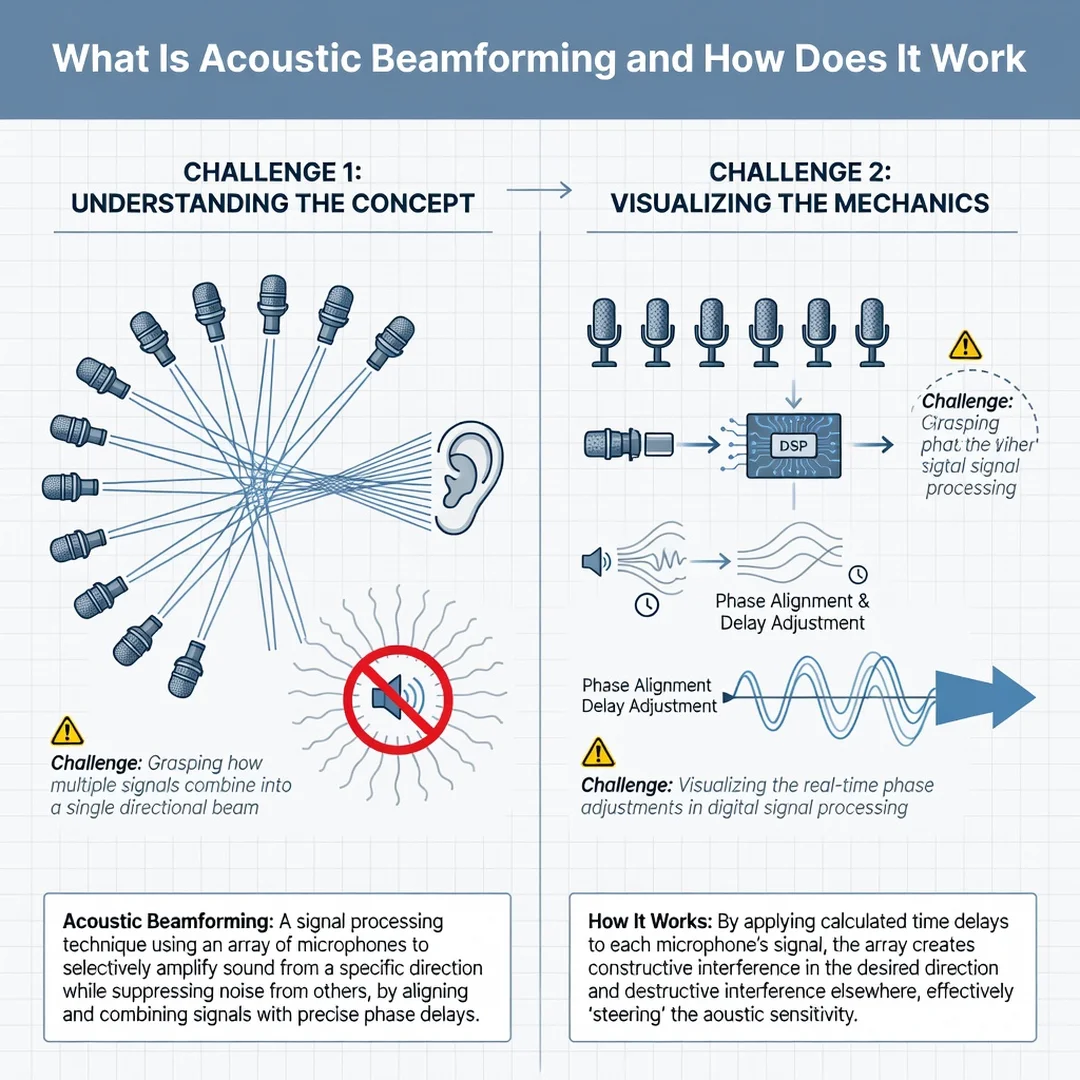
A microphone array is simply a group of microphones arranged in a known geometry, such as a line, a circle, or a grid. The spacing between microphones matters because it determines which frequencies the array can handle effectively. A common rule of thumb is that microphone spacing should be no more than half the wavelength of the highest frequency of interest to avoid spatial aliasing, which is the acoustic equivalent of a visual illusion that confuses the system about where sound is coming from.
Time Difference of Arrival
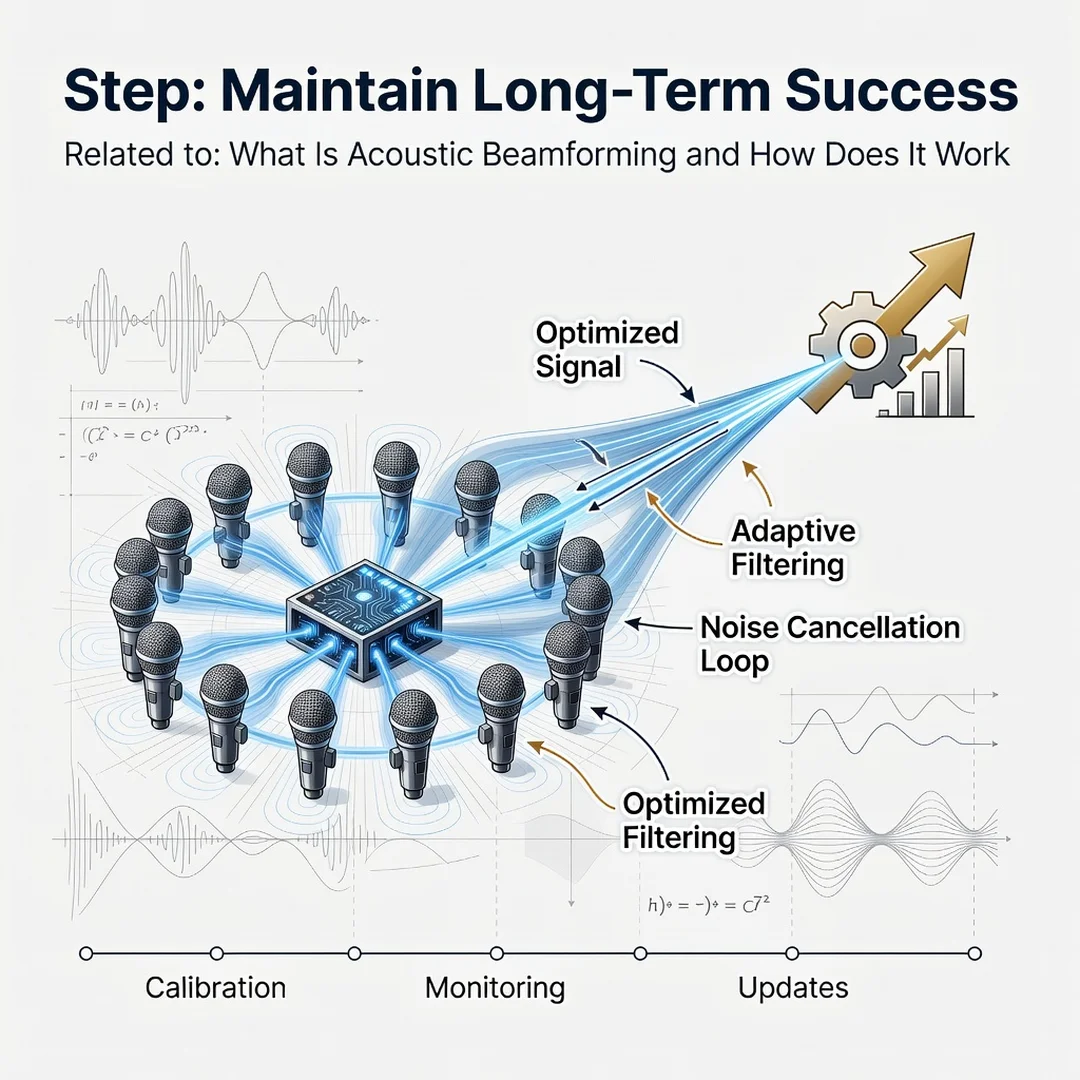
When a sound wave reaches an array, it does not hit every microphone at the same instant. The tiny differences in arrival time, called time difference of arrival (TDOA), depend on the direction of the sound source and the array geometry. Beamforming algorithms use these delays to figure out where the sound is coming from and to combine the microphone signals in a way that reinforces the desired direction.
Constructive and Destructive Interference
Once the delays are known, the system can delay each microphone signal so that sounds from the target direction line up in phase. When signals line up, they add together constructively, boosting the target. Sounds from other directions arrive with mismatched phases and cancel each other out destructively. This phase alignment is the heart of beamforming.
Beam Pattern and Directivity
The beam pattern describes how sensitive the array is to sound from different directions. A narrow beam focuses tightly on one direction, while a broad beam captures a wider area. Directivity is a measure of how much the array favors the target direction over others. More microphones generally produce a narrower beam and higher directivity, but they also demand more processing power and careful calibration.
Fixed vs. Adaptive Beamforming
Fixed beamformers use predetermined weights and delays, which makes them simple and predictable. Adaptive beamformers, such as the minimum variance distortionless response (MVDR) method, adjust their weights in real time based on the incoming sound field. Adaptive systems can suppress moving noise sources better, but they are more complex and can misbehave if not carefully constrained.
Deep Dive
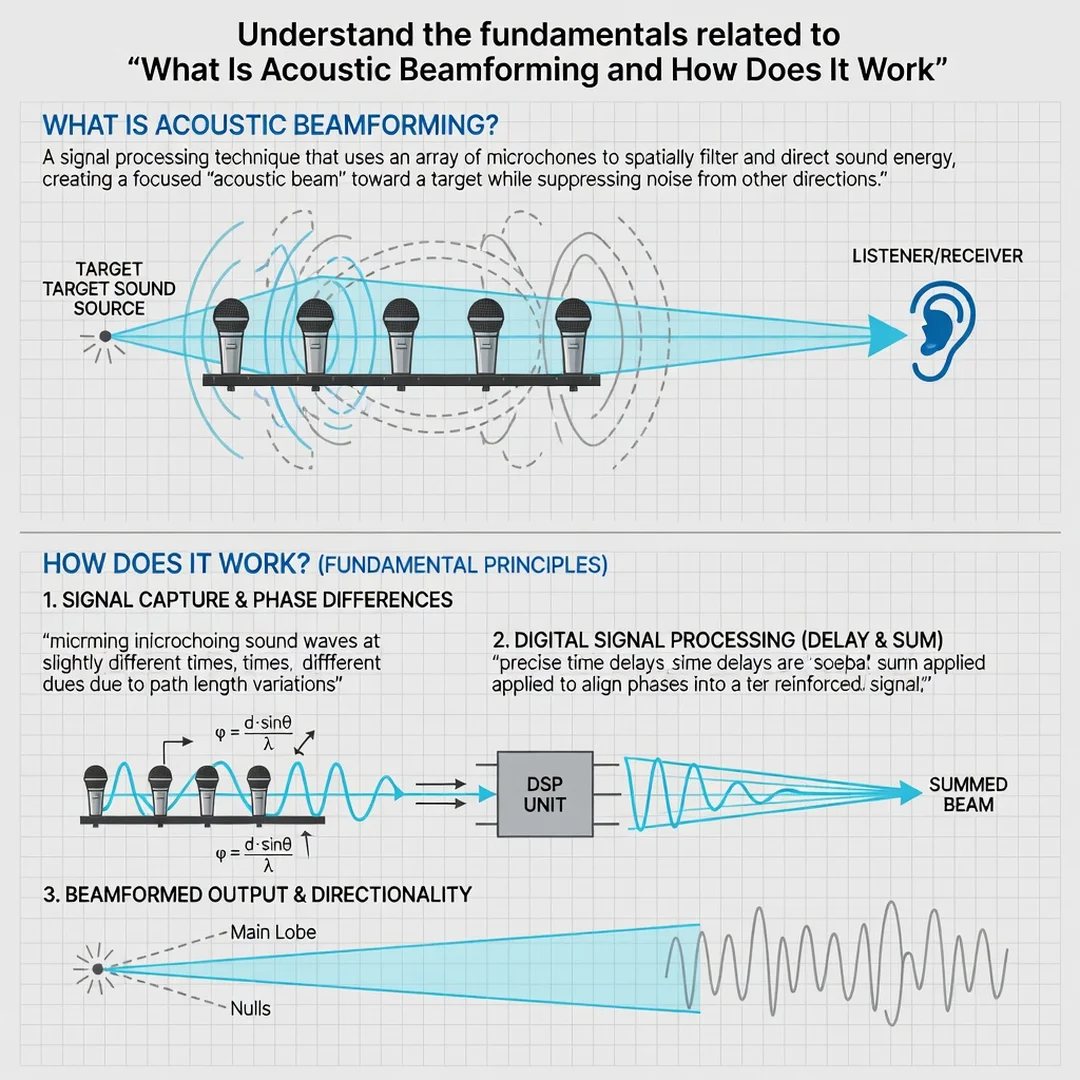
Now that the vocabulary is clear, let’s look at the machinery. Acoustic beamforming works in three main stages: capture, processing, and output.
Stage 1: Capture
Each microphone in the array converts sound pressure into an electrical signal. The microphones must be matched in sensitivity and phase response; otherwise the beamformer’s carefully calculated delays will be thrown off. In practice, manufacturers calibrate arrays or use self-calibration routines to keep channels consistent.
Stage 2: Processing
The processing stage is where the magic happens. The system first estimates the direction of arrival (DOA) of the target sound. Classic methods include the delay-and-sum beamformer, which simply delays and adds signals, and the filter-and-sum beamformer, which applies frequency-dependent filters before summing. More advanced methods use frequency-domain processing via the fast Fourier transform (FFT). In the frequency domain, a delay becomes a phase shift, and the beamformer applies a complex weight to each microphone’s spectrum before summing. This makes it easy to steer the beam and shape the response.
Adaptive algorithms go further. They analyze the covariance matrix of the microphone signals and compute weights that minimize total output power while preserving the target direction. This is powerful for rejecting interference, but it requires enough data to estimate the statistics reliably. In reverberant rooms, where sound bounces off walls, beamformers are often combined with dereverberation or post-filtering to clean up the output.
Stage 3: Output
The final output is a single audio stream that emphasizes the target direction. In some systems, the beamformer produces multiple beams simultaneously, each pointing in a different direction. This is common in conference room microphones that track who is speaking, or in smart speakers that need to distinguish between a wake word and background conversation.
Practical Limits
Beamforming is not magic. Its performance depends on frequency. At low frequencies, where wavelengths are long compared to microphone spacing, the beam becomes wide and directivity drops. At high frequencies, spatial aliasing can create unwanted sidelobes, which are sensitivity peaks in directions other than the target. Designers often use nested arrays, with different spacings for different frequency bands, to cover a wide range. Reverberation, background noise, and microphone mismatches all chip away at performance, so real-world systems blend beamforming with noise suppression, echo cancellation, and machine learning.
Step-by-Step Guide
If you are planning to use or build an acoustic beamforming system, the following steps provide a practical path. Each step builds on the previous one, so resist the urge to skip ahead.
Step 1: Understand the fundamentals
Start by solidifying your grasp of microphone arrays, time difference of arrival, and beam patterns. Read application notes from microphone manufacturers and try a simple simulation in a tool like Python with NumPy or MATLAB. Plot the beam pattern for a linear array of four microphones and see how the main lobe changes with frequency. This hands-on exercise makes the abstract math concrete and will save you from costly design mistakes later.
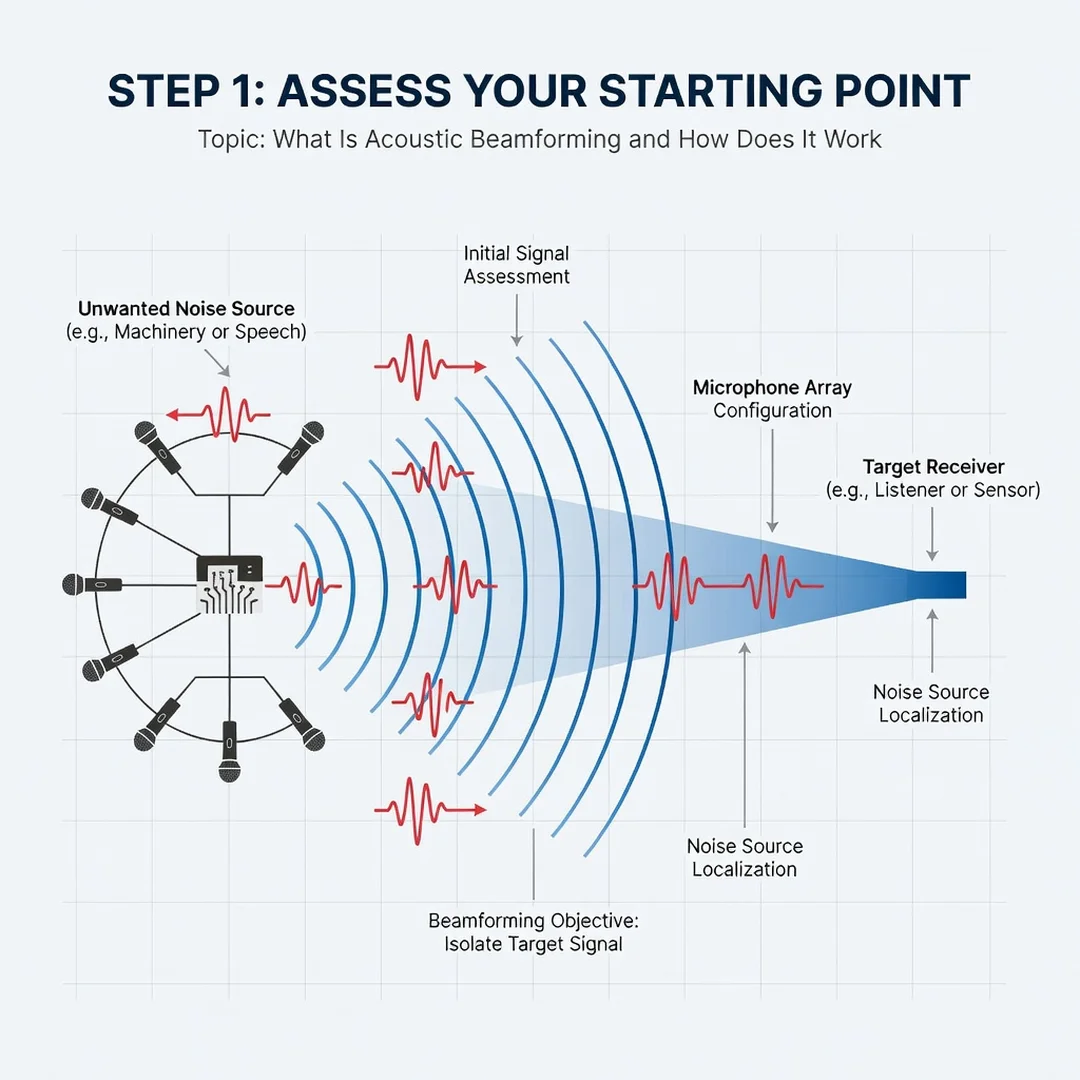
Step 2: Assess your starting point
Evaluate your current setup or the product you are considering. How many microphones does it have? What is the spacing? What is the intended environment—a quiet living room, a noisy factory floor, or a reverberant conference hall? Measure or research the noise levels and reverberation time you expect. If you are buying a device, look for specifications like beam width and signal-to-noise ratio improvement. If you are building, document your constraints: power budget, processing capacity, physical size, and cost.
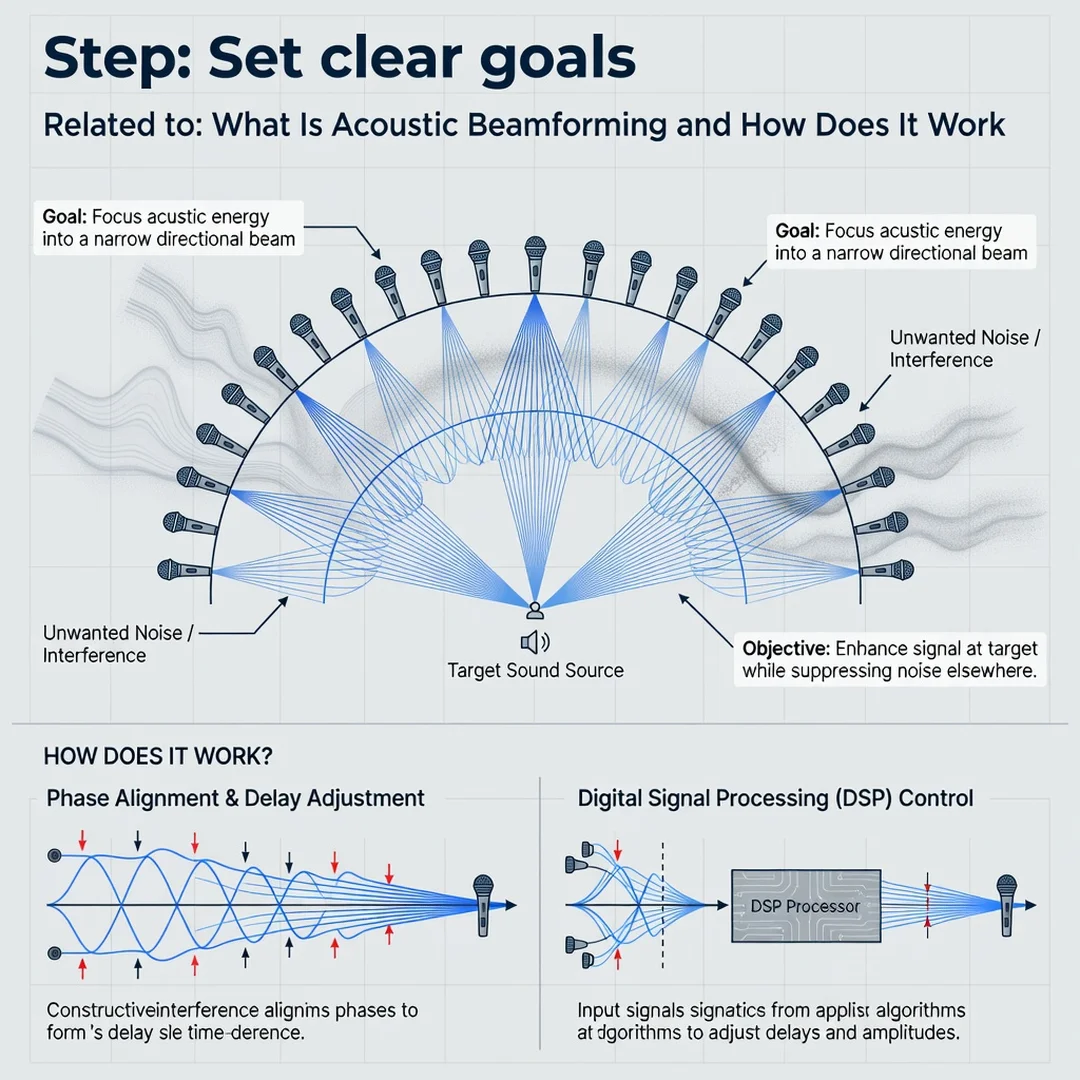
Step 3: Set clear goals
Define what success looks like. Are you trying to improve speech recognition accuracy in a noisy room? Do you need to isolate a single speaker in a meeting? Or are you designing a directional listening device for nature recording? Write down measurable targets, such as “improve signal-to-noise ratio by 10 dB for a source 3 meters away” or “reduce word error rate by 20 percent.” Clear goals guide every subsequent decision, from array geometry to algorithm choice.
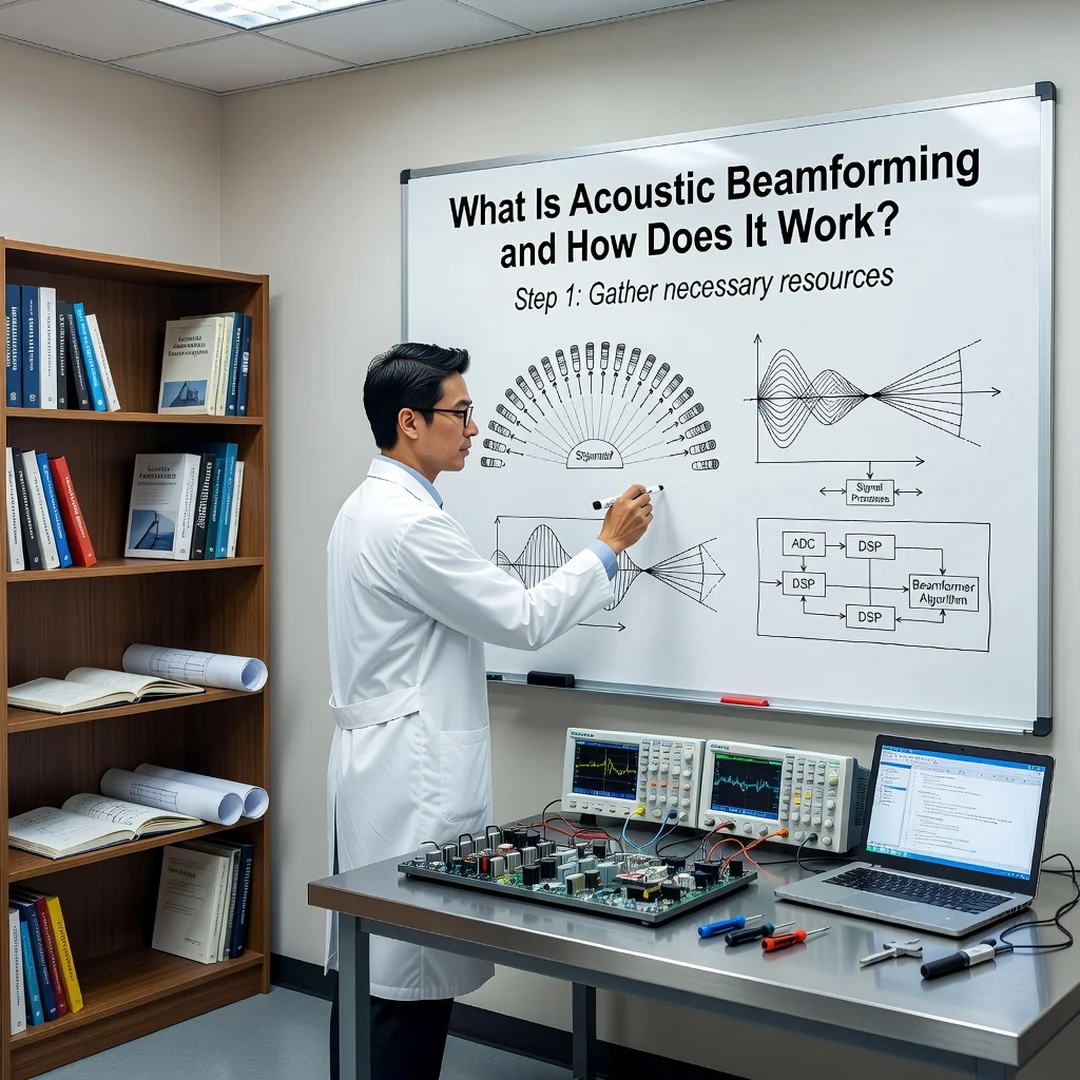
Step 4: Gather necessary resources
Collect the hardware and software you need. For hardware, choose microphones with matched frequency response and low self-noise. A digital MEMS microphone array is often easier to integrate than analog electret condensers because the digital output simplifies synchronization. For processing, you will need a digital signal processor (DSP), a field-programmable gate array (FPGA), or a capable CPU/GPU. On the software side, libraries like Pyroomacoustics, WebRTC’s audio processing module, or commercial beamforming toolkits can accelerate development. Do not forget test equipment: a calibrated sound source, a rotating turntable for angle sweeps, and acoustic measurement software.
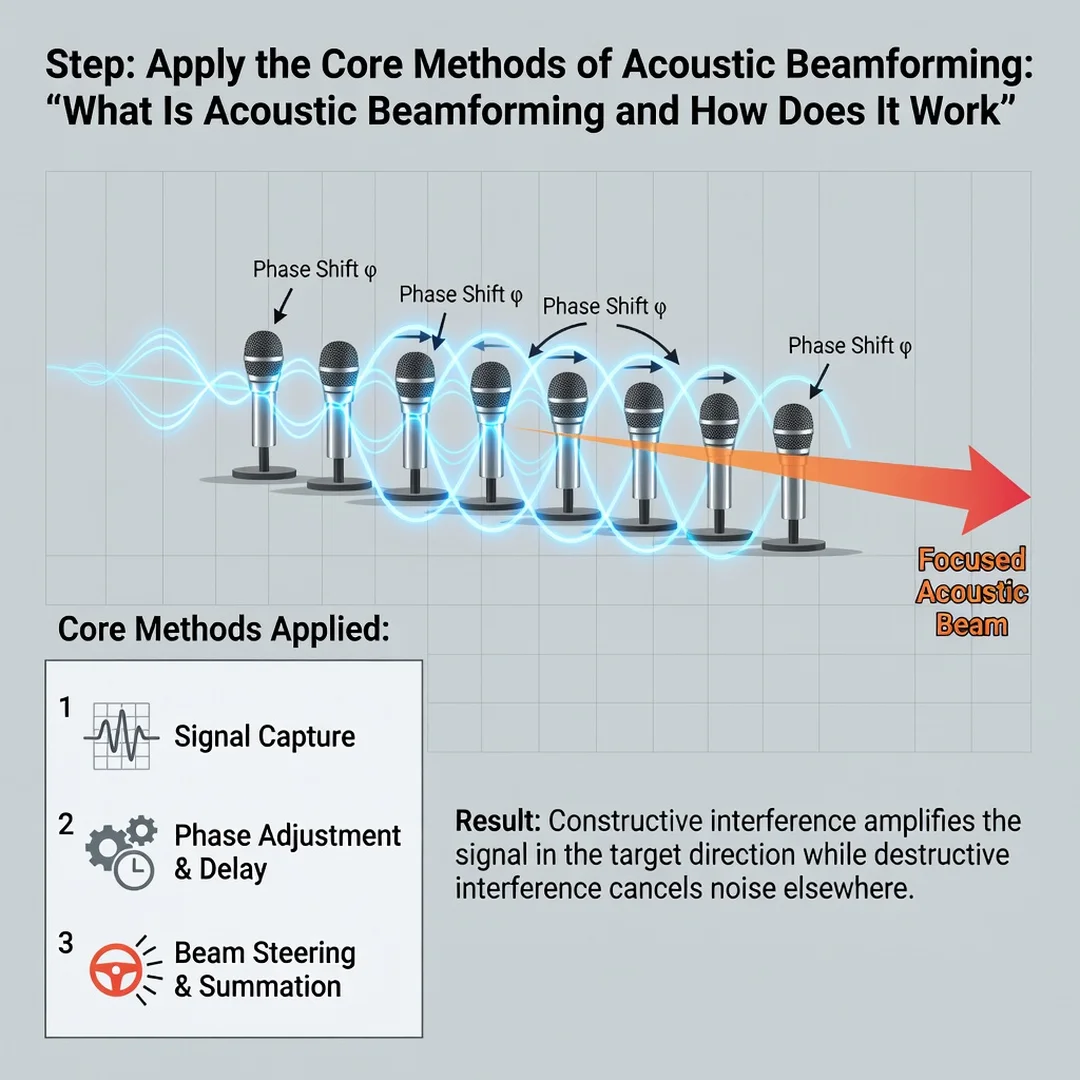
Step 5: Apply the core methods
Begin with a delay-and-sum beamformer to establish a baseline. Implement it in the frequency domain for flexibility. Then, if needed, move to an adaptive method like MVDR. Tune the regularization parameter to avoid over-suppressing the target in reverberant conditions. Combine the beamformer with a post-filter that attenuates residual noise based on the estimated noise field. Test with real recordings, not just simulations, because real rooms introduce effects that simulations miss. Iterate on your design: adjust microphone spacing, change the number of microphones, or switch algorithms until your metrics meet the goals you set in Step 3.
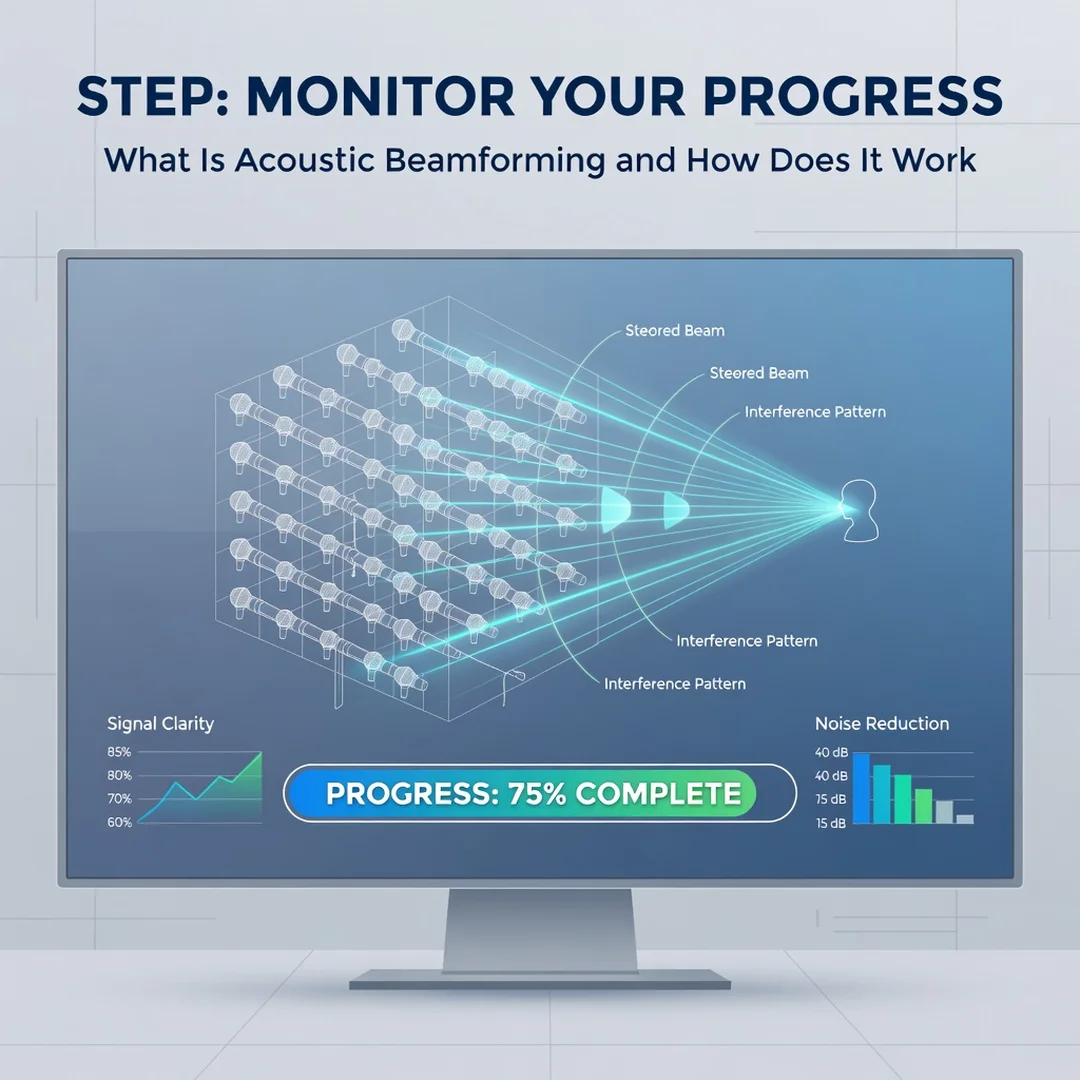
Step 6: Monitor your progress
After deployment, keep measuring. Track key metrics such as signal-to-noise ratio improvement, speech intelligibility scores, and false-trigger rates. Log performance across different environments and over time, because microphone performance can drift with dust, moisture, or age. Consistent monitoring catches problems early and provides data for future improvements. Reliable information and consistent habits lead to better long-term outcomes, so make evaluation a routine, not a one-time event.
Best Practices
To get the most from acoustic beamforming, follow these guidelines drawn from real-world deployments.
- Match your microphones: Use identical models and calibrate them. A single mismatched microphone can raise the noise floor of the entire array.
- Design for your frequency range: Use nested or multi-radius arrays if you need broad frequency coverage. Avoid spacing that causes aliasing in your band of interest.
- Combine with other techniques: Beamforming alone rarely solves every problem. Pair it with noise suppression, echo cancellation, and automatic gain control for robust performance.
- Test in the real environment: Anechoic chamber results are a starting point. Always validate in the actual room with real noise sources.
- Keep processing real-time: For live applications, ensure your algorithm meets latency requirements. A perfect beamformer that lags by 500 milliseconds is useless for conversation.
Document and version your configurations: Small changes in weights or geometry can have big effects. Maintain clear records so you can.
You now have a solid foundation for What Is Acoustic Beamforming and How Does It Work. Apply the best practices above and revisit this guide as your needs evolve.